⚽ Emsport
📘 Comprehensive teaching of the 1x1 game to children and teenagers
🔥 EXERCISE
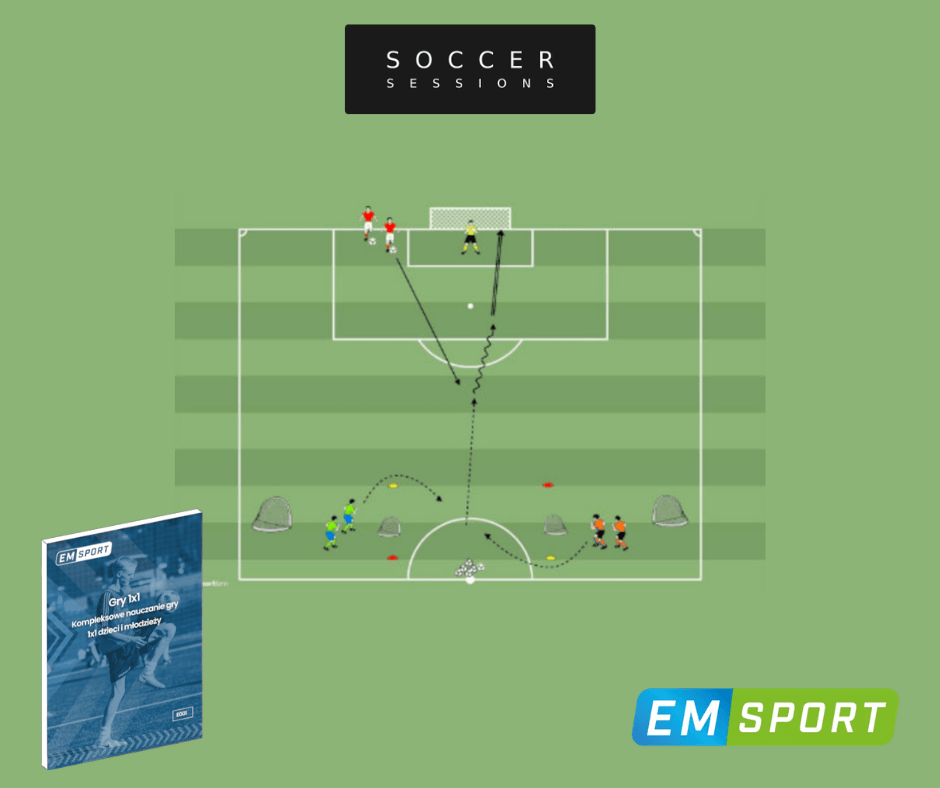
Transition from a 1v1 game with 2 goals
PROCEDURE:
Transition from a 1v1 game with 2 goals – opponent to the side of the direction of play – to a 1v1 game – opponent in front.
Players positioned as shown in the diagram. On the coach`s sound signal, the player reacts to the colour by running through the corresponding colour behind the cone at the corners of the playing area and takes on a 1v1 duel. The player who wins the 1v1 duel moves on to a 1v1 against an opponent facing them. When the ball is won in the defending phase, the player takes the ball to one of the two goals.
COMPETITION:
A player can score the following number of points in one exercise:
for winning the race combined with reaction speed – 1 pt,
for winning the 1v1 duel in the attacking phase – 1 pt,
for winning the 1v1 duel in the defending phase – 2 pts.
In each exercise, every player can score points for completed tasks. The player with the most points at the end of the exercise wins.
MODIFICATIONS:
1v1 on a sound signal (2 cone colours),
1v1 on a visual signal (2 cone colours),
1v1 on a sound or visual signal; after the signal the player touches the cone of the corresponding colour with the right/left foot,
1v1 on a sound or visual signal; after the signal the player performs a general exercise and touches the cone of the corresponding colour with the right/left foot,
1v1 as above, but the player reacts to the colours the other way round, i.e. on blue they go to red - on red to blue, on yellow to white – on white to yellow.
There are many ways to modify the exercise; we have presented a few to serve as inspiration for the coach.
COACHING POINTS:
TECHNIQUE - dribbling speed
TACTICS - correct positioning in relation to the attacker
MOTOR SKILLS - reaction speed
MENTALITY - building self-confidence in 1v1 attacking / coping with time and space pressure
NOTES:
In the attacking phase:
draw the player`s attention to the moment they perform a feint against the defender – the right distance,
first touch – a progressive first touch on the run,
accelerating with the ball when completing a dribble,
pay attention to the player`s reaction speed during the A/D and D/A transitions,
draw the player`s attention to a first touch geared towards dribbling (the first touch can be both receiving the ball and an effective dribble).
In the defending phase:
showing the attacker onto their weaker foot (observing and quickly analysing based on how they receive the ball),
the player`s staggered defensive stance,
building the habit of closing down immediately to press,
draw the player`s attention to the correct body position that forces the attacker towards the touchline,
teaching the player to retreat (slow down the attack) in the defending phase in order to build a numerical advantage in defence.
🚀 Looking for ready-made outlines and exercises for coaches of all ages?
Get access to a database of over 4,000 training materials from our partners